
Sewage Backup in Your Home: What to Do First
August 3, 2026 · Alpha Omega Plumbing Inc
If wastewater is rising out of a floor drain, a shower pan, or the lowest toilet in the house, stop using water everywhere in the home immediately — every flush and every sink you run adds to what's already coming back at you. A sewage backup is not an ordinary clog; it means the drainage system has lost its outlet, and what's surfacing is contaminated water that carries a real health risk. This guide walks through why backups happen in O'ahu homes, what the contamination actually threatens, the steps that matter in the first ten minutes, and how the blockage gets cleared for good. If you're in the middle of one right now, call Alpha Omega Plumbing at (808) 847-5414 — we run 24/7 emergency plumbing service across the island.
Why Main Sewer Lines Back Up in Island Homes
The difference between a slow sink and a backup is where the obstruction sits. A clog in a fixture branch affects that fixture alone — the tub drains poorly, everything else works fine. When the main line to the street or the septic tank is blocked, the entire house has nowhere to drain, and wastewater takes the path of least resistance: the lowest opening in the building. That's why the classic first symptom is a ground-floor shower or a basement floor drain filling up when someone flushes a toilet upstairs.
Tree and shrub roots are the most common culprit in older neighborhoods. Hawai'i's year-round growing season means roots never go dormant, and they are drawn to the moisture and nutrients leaking from any hairline crack or loosened joint in a buried line. A few fine roots enter, then thicken into a mat that catches everything passing by. Clay and cast-iron laterals — standard in much of Honolulu, Kaimuki, Manoa, and Kalihi — are especially vulnerable, and decades of salt air and soil movement don't help the joints.
Grease is the other reliable offender. Cooking oil poured down a drain leaves the kitchen as a warm liquid and cools into a waxy deposit on the pipe wall a few feet out, narrowing the line a little more with every meal. Add so-called flushable wipes — which do not break down the way toilet paper does — plus paper towels, feminine products, and the occasional child's toy, and you have the second half of the equation. On the municipal side, heavy rain can surcharge the public sewer itself; the EPA tracks sanitary sewer overflows as a recognized problem in aging systems nationwide, and when the street main is full, your lateral has nowhere to discharge. A home on a septic system shows the same symptoms for a different reason: an overfull tank or a saturated leach field.
The Health Risk of Raw Wastewater Indoors
Treat anything that comes up a drain as contaminated, no matter how much it looks like dirty water. Sewage carries bacteria, viruses, and parasites — E. coli, salmonella, hepatitis A, giardia among them — and exposure happens through skin contact, through hand-to-mouth transfer, and through inhaling aerosolized droplets in a poorly ventilated bathroom. Children and pets are the ones most likely to wander into it, so getting them out of the affected rooms is the first move, ahead of any cleanup.
Damage adds up faster than most homeowners expect. Water wicks upward into drywall and baseboards, soaks into subfloor and carpet padding, and spreads under vinyl and laminate flooring where you can't see it. In Hawai'i's humidity, material that stays wet begins growing mold within roughly 24 to 48 hours, which turns a plumbing problem into a remediation project. Porous materials that have absorbed sewage — carpet, pad, and saturated drywall — generally cannot be salvaged and need to come out.
There's an electrical hazard too, and it's the one people underestimate. If standing water has reached outlets, extension cords, or an appliance, don't step into it. Shut power to the affected area at the breaker panel if you can reach it safely and dry, and if you can't, leave the area alone and wait. Nothing on the floor is worth a shock.
Emergency Steps to Take Before the Plumber Arrives
Stop all water use first. No flushing, no laundry, no dishwasher, no showers — not in any part of the house. A washing machine mid-cycle will dump thirty gallons into a line that already has nowhere to go, and that alone can turn a contained backup into a flooded hallway. Tell everyone in the home, because one absent-minded flush undoes everything else you do.
Then close the door on the affected room and keep people and pets out. If the sewage is spreading toward carpet or a doorway, old towels along the threshold buy you time. Open a window for ventilation, but don't run a fan across the wet area — that pushes contaminated aerosols through the rest of the house. Resist the urge to reach for a chemical drain opener: it will not touch a main-line blockage, and it turns everything on the floor into a caustic mess that's hazardous for whoever cleans it up.
Document the damage while you wait. Photos and a short video of the affected rooms, taken before anything is moved or cleaned, are what your insurer will ask for, and many policies cover sewer backup only under a specific endorsement — worth knowing before you file. If you can safely locate your main cleanout, usually a capped pipe outside near the foundation or along the lateral run toward the street, note where it is; the technician will go straight to it. Then call (808) 847-5414. A blocked main sewer line is a genuine emergency, and the sooner the line is opened, the less material ends up inside the house.
Clearing the Blockage and Preventing the Next One
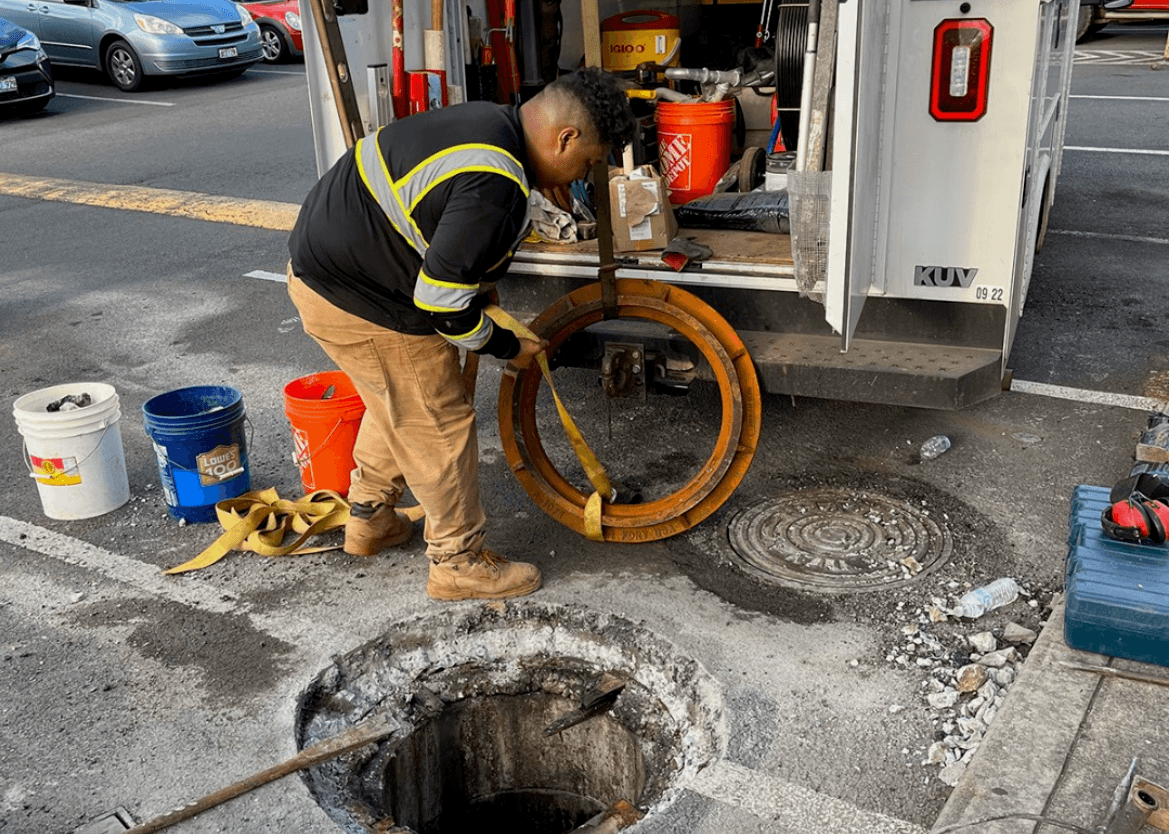
Once we're on site, the work goes in order: open the cleanout to relieve pressure and get the standing wastewater draining, clear the obstruction, then find out what caused it. A cable machine cuts through roots and breaks up a soft blockage quickly, which restores flow — but a cleared line and a healthy line aren't the same thing. That's why a video camera inspection matters after the fact. Running a camera down the lateral shows whether you're looking at a one-time obstruction, a root intrusion that will return in six months, a belly holding water, or a cracked section that needs repair or lining.
For lines coated in years of grease and scale, cabling punches a hole through the middle and leaves the buildup on the walls. Hydro jetting scours the pipe back to its full diameter with high-pressure water, which is the difference between a fix that lasts a few months and one that lasts years. Where the camera finds structural damage, trenchless lining or pipe bursting can rebuild the line without trenching up a driveway or a mature yard.
Prevention is mostly a short list of habits. Keep grease out of the drain — let it cool and bin it. Flush nothing but toilet paper, whatever the packaging on the wipes claims. If you have mature trees near the lateral, schedule a preventive cleaning every year or two rather than waiting for the next backup. On a septic system, pump on schedule instead of on symptoms. And take the early warnings seriously: gurgling drains, a toilet whose level rises when you run the washer, or several fixtures draining slowly at once are the main line telling you it's closing up.
Alpha Omega Plumbing has handled sewer emergencies across O'ahu since 2014, from Hawai'i Kai to Kapolei, and we answer the phone at every hour because backups don't keep business hours. If wastewater is coming up in your home right now, call (808) 847-5414 and we'll get a technician moving.
Frequently Asked Questions
What should I do first when sewage backs up into my house?
Stop using water everywhere in the home, keep people and pets out of the affected room, and don't touch standing water that has reached outlets or appliances. Photograph the damage for your insurer, then call a plumber. Alpha Omega Plumbing answers 24/7 at (808) 847-5414.
How much does it cost to fix a sewer backup in Hawaii?
It depends on what the line needs — a straightforward cabling to clear roots or a soft blockage sits at the low end, while hydro jetting, spot repair, or relining a collapsed section costs more. Hawai'i labor and material rates run above the mainland. Alpha Omega Plumbing gives free estimates at (808) 847-5414.
Why do O'ahu homes get sewer line problems so often?
A year-round growing season means tree roots never stop seeking moisture in buried lines, and many Honolulu-area neighborhoods still have original clay or cast-iron laterals with joints that roots can enter. Heavy rain can also surcharge the public main, leaving your lateral with nowhere to drain.
Can I clear a sewage backup myself?
A plunger or a hand auger may clear a single blocked fixture, but a whole-house backup means the main line is obstructed and needs professional equipment — and chemical drain openers make the cleanup hazardous without helping. Call Alpha Omega Plumbing at (808) 847-5414 for main-line work.
Learn more about our Clogged Sewer Line Service services on Oʻahu
blocked main sewer line →Alpha Omega Plumbing Inc
Serving all of O'ahu since 2014.
More From the Blog
Need a Plumber on O'ahu?
Insured and available 24/7 for emergencies across the island.